The GENIUS Act and MiCA will split stablecoins into cash and shadow deposits
Stablecoins are increasingly defined not by claims of being fully backed but by who can actually redeem at par during a crisis. The core risk is shifting from whether reserves exist to whether they remain legally and operationally accessible when trust breaks down, as seen during the Silicon Valley Bank episode when USDC briefly lost its peg due to temporary reserve inaccessibility. Regulators are now embedding this lesson into law. The GENIUS Act in the United States establishes strict rules for payment stablecoins, including tight reserve requirements and a prohibition on yield-for-holding to prevent bank-like run dynamics. In contrast, Europe’s MiCA framework focusses on legally enforceable redemption rights and introduces mechanisms to restrain stablecoins that grow into systemically important payment rails.
Together, these regimes are shaping a two-tier stablecoin market. The most tightly regulated tokens will resemble digital cash, supported by statutory redemption rights, high-quality liquid reserves and strict limits on yield features. Other designs may function like cash in normal conditions but behave more like credit instruments during stress, particularly where rewards programs, wrappers or cross-border multi-issuance structures introduce hidden fragilities. The critical evaluation metric becomes legal priority and liquidity under panic conditions, including whether redemption rights apply universally, whether reserves remain reachable during banking disruptions and whether jurisdictional differences could create run magnets. Stablecoins are evolving into financial institutions where legal architecture, not branding, determines whether a peg survives systemic shocks. Source
Miner Offloads $305M Bitcoin as Network Difficulty Sees Sharp Decline
Bitcoin mining conditions worsened in late January and early February as network difficulty fell 14.1% across two consecutive downward adjustments, signalling that less efficient mining equipment was being taken offline. This shift coincided with a roughly 25% drop in Bitcoin’s price, which briefly touched $60,000 before recovering toward $70,000. Despite the tougher environment and shrinking margins, on-chain data indicates that miners are not engaging in widespread selling. Aggregate transfers from miners to exchanges have remained stable, with daily flows near recent norms and no sustained spikes suggesting forced liquidations.
Amid these pressures, publicly traded miner Cango disclosed the sale of 4,451 BTC worth approximately $305 million, framing the move as balance sheet strengthening rather than distress. Profitability metrics, including the Puell Multiple, point to elevated stress levels, reflecting miner revenues below historical averages. This dynamic typically encourages liquidity preservation and selective reserve sales instead of expansion. The adjustment phase is currently manifesting through hashrate reductions rather than aggressive dumping, though analysts warn that a renewed decline below $60,000 could intensify financial strain and trigger additional sales across the sector. Source
UK regulator takes High Court action against HTX over crypto promotions
The UK Financial Conduct Authority has initiated legal proceedings against cryptocurrency exchange HTX, alleging the firm illegally promoted crypto asset services to British consumers in violation of financial advertising regulations. The case, filed in the Chancery Division of the High Court, follows the FCA’s adoption of the Financial Promotions Regime, which imposes strict requirements on how crypto-related services can be marketed in the United Kingdom. The regulator obtained permission to serve proceedings outside the UK and through alternative methods, noting that HTX is incorporated in Panama.
The FCA stated that HTX continued advertising crypto services across multiple social media platforms despite prior warnings, describing such unauthorised promotions as a criminal offence. The regulator emphasised that its rules are intended to protect consumers from misleading marketing while supporting a sustainable crypto market. In response, the FCA has asked social media companies to restrict HTX’s accounts for UK users, requested removal of the exchange’s apps from UK app stores and placed the firm on its Warning List, cautioning consumers that they lack regulatory protection. Source
Bitmine Ignores $7.8B Paper Losses, Buys $83M Worth of ETH as Market Dips
BitMine, the Ethereum-focused treasury firm chaired by Tom Lee, expanded its holdings with roughly $83 million in ETH purchases during a period of heightened volatility and price weakness. On-chain data indicates the firm acquired two separate blocks of 20,000 ETH through institutional platforms, adding to a series of large weekly purchases. The company now holds approximately 4.32 million ETH at an average acquisition cost far above current market prices, leaving its position with substantial unrealised losses. Despite this, Lee has characterised the downturn as a market dislocation rather than a reflection of deteriorating network fundamentals, pointing to metrics such as elevated transaction activity.
Ethereum’s price continues to struggle, posting steep declines over weekly and monthly timeframes, while on-chain flows reveal contrasting behaviour among major holders. Some large entities have exited positions and realised significant losses, whereas BitMine has maintained an accumulation strategy, emphasising the absence of debt obligations that might force liquidations. At the same time, declining ETH reserves on exchanges suggest a broader reduction in readily available sell-side liquidity, highlighting a split market dynamic between capitulation-driven selling and long-term conviction buying. Source
White House crypto bill talks ‘productive,’ but no deal yet
Discussions at the White House between crypto industry representatives and banking groups over stablecoin provisions in a proposed crypto market structure bill were described as productive but failed to produce an agreement. The meeting, the second in recent weeks, focused heavily on stablecoin rewards and yield payments, an issue that continues to divide the two sides. While crypto advocates pointed to bipartisan momentum for legislation defining regulatory oversight of digital assets, progress has slowed after the Senate Banking Committee struggled to secure sufficient support. Momentum was further weakened when Coinbase withdrew its backing due to provisions that would ban yield payments tied to stablecoins.
Banking lobbyists maintained that yield-bearing stablecoins could threaten traditional bank deposits and broader financial stability, arriving at the meeting with principles advocating prohibition rather than negotiating specific bill language. Major banking associations called for continued discussions, emphasising the need to balance financial innovation with safety and soundness. Meanwhile, industry voices argued against revisiting prior legislation that already restricted stablecoin issuers from paying yield directly, warning that renewed disputes could delay broader market structure reforms. Source
UK central bank taps companies for distributed ledger settlement
The Bank of England has launched the Synchronisation Lab, a six-month industry experimentation initiative designed to explore how tokenized assets could be settled using synchronised, atomic settlement in pounds sterling. The pilot will involve 18 selected participants testing delivery-versus-payment and payment-versus-payment mechanisms between the Bank’s next-generation real-time gross settlement core ledger, RT2, and external distributed-ledger platforms. Conducted in a non-live environment without real money, the program aims to validate design choices for synchronised settlement, evaluate interoperability between central bank money and tokenized assets, and inform the potential development of a live RTGS synchronisation capability. The participants include banks, market infrastructure providers, fintech firms, and decentralised technology companies examining use cases such as tokenized securities settlement, collateral optimisation, foreign exchange, and digital-money issuance.
Web3-focused firms including Chainlink and UAC Labs will test decentralised coordination models for synchronised settlement, while companies such as Ctrl Alt and Monee will focus on settlement for tokenized gilts and securities. Other participants will explore conditional margin payments and digital-money issuance and redemption workflows, alongside established players like Swift and LSEG. The initiative reflects a broader global trend, as central banks increasingly examine tokenization, programmable settlement, and digital currencies. Recent efforts include research from the Federal Reserve Bank of New York and the Bank for International Settlements on smart contracts for monetary policy, Singapore’s BLOOM initiative for tokenized liabilities and stablecoins, and CBDC trials across Australia, the UAE, and China-led cross-border projects. Source
CZ: Binance Leads Major Stablecoins, Not Just USD1
Binance users reportedly hold about 87% of the circulating supply of USD1, a stablecoin linked to World Liberty Financial, a crypto venture backed by members of President Donald Trump’s family. Data cited from Arkham Intelligence indicates Binance controls roughly $4.7 billion of the token’s $5.4 billion supply, a level of concentration that exceeds the exchange holdings seen for other top stablecoins. The figures sparked criticism from industry observers, who raised concerns about custody risk and questioned whether USD1 was designed for broad market use. Binance founder Changpeng Zhao dismissed the controversy, arguing that Binance typically holds the largest share of most major stablecoins due to user demand rather than preferential treatment.
The debate unfolded alongside broader scrutiny of Zhao and Binance, including lingering attention following Zhao’s 2025 presidential pardon tied to earlier compliance violations. Binance executives have also pointed to what they describe as coordinated fear, uncertainty, and doubt campaigns, citing incidents involving AI-generated impersonation accounts and analysis alleging organised smear efforts. Market data continues to highlight Binance’s dominant position, with reports showing the exchange captured significant shares of global spot and derivatives trading volume and held the majority of combined USDT and USDC reserves across major platforms, reinforcing Zhao’s claim that large stablecoin balances on Binance are typical. Source
Markethive Supergroups: The Hub for Marketing Campaigns and Lead Nurturing

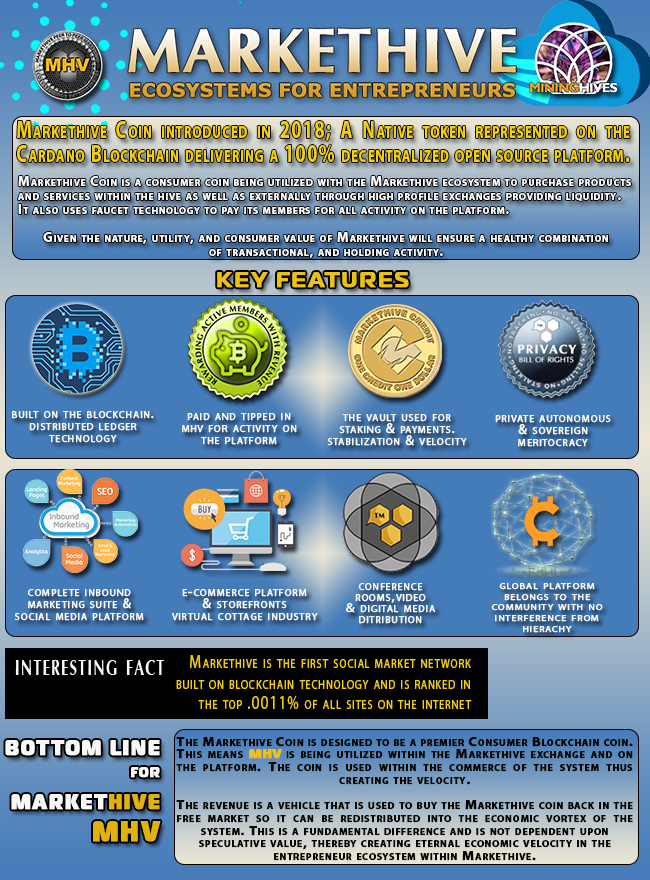
Markethive Supergroups are presented as customisable, integrated environments that combine social networking, e-commerce, and marketing automation into a unified system designed for entrepreneurs and businesses. They function as branded storefronts and community hubs where advertising funnels, capture pages, splash pages, and newsfeeds work together to streamline lead generation, engagement, and conversion. The system emphasises synchronised marketing capabilities, including email campaigns, content distribution, broadcasting tools, shopping cart integration, and collaborative blogging features, while providing administrators with activity tracking and performance reporting across member actions, traffic flows, and promotional efforts.
The framework also incorporates incentive mechanisms such as token airdrops and vanity promo codes, alongside a structured referral system that attributes sign-ups through profile links, permalinks, or rotator links. Cooperative advertising tools allow members to pool resources for shared campaigns with automated share allocation and tracking, supported by vendor management, URL shortening, website rotators, keyword monitoring, and backlink verification. Overall, Supergroups are positioned as an all-in-one marketing and lead nurturing ecosystem aimed at scaling outreach, improving collaboration, optimising traffic distribution, and strengthening community-driven business growth. Source
Ledger adds OKX DEX integration for on-device token swaps
Ledger has integrated OKX DEX into its wallet app, allowing users to perform multichain token swaps directly within a self-custodial environment while maintaining hardware-level security. The integration provides access to OKX DEX’s aggregated liquidity, with trades routed through OKX’s X-Routing technology to find efficient execution paths across numerous decentralised exchanges. All transactions are signed on the Ledger device, ensuring private keys never leave the hardware wallet. The rollout is gradual, initially reaching roughly 20% of users without requiring firmware or app updates. At launch, swaps are supported on Ethereum, Arbitrum, Optimism, Base, Polygon and BNB Chain, though cross-chain and cross-seed swaps are not enabled.
The move comes amid broader industry momentum toward public listings. Reports in January suggested Ledger was exploring a US IPO that could value the company above $4 billion, although the firm declined to confirm. Other crypto companies are also pursuing or considering listings, including Securitise, which reported sharp revenue growth ahead of its blank-check merger plans, and Copper, which was said to be evaluating options despite downplaying IPO intentions. Kraken is likewise expected to go public in 2026 after confidential SEC filings, though recent reports indicate executive changes, including the removal of its chief financial officer. Source
Tokenized commodities market crosses $6B amid gold’s historic rally
The tokenized commodities market has surged past $6.1 billion after climbing 53% in less than six weeks, driven overwhelmingly by gold-backed digital assets. Tether Gold and Paxos-issued PAX Gold dominate the sector, together accounting for more than 95% of total market value. Since the start of the year, roughly $2 billion has flowed into tokenized commodities, marking one of the fastest expansions within the broader real-world asset tokenization space. Year-on-year growth now stands at 360%, significantly outpacing tokenized stocks and funds, while positioning tokenized commodities at over one-third the size of the tokenized funds market and far ahead of tokenized equities.
The rapid growth aligns with gold’s powerful price rally, which has seen the metal climb more than 80% over the past year and recently establish new highs before stabilising above $5,000. Tether has reinforced its commitment to tokenized gold through a major investment in Gold.com, aiming to integrate its XAUt token and potentially enable physical gold purchases using stablecoins. In contrast, Bitcoin has struggled to regain momentum following a sharp correction, fuelling debate over whether the asset behaves more like a high-risk technology stock than a traditional safe haven. Market observers note that Bitcoin’s divergence from gold during this period has challenged the long-standing digital gold narrative. Source
Robinhood’s Ethereum Layer-2 Network Enters Public Testnet Phase
Robinhood has launched a public testnet for its Ethereum layer-2 network, Robinhood Chain, allowing developers to experiment with applications and provide technical feedback. The initiative aims to create a controlled environment to evaluate the network’s capabilities as it integrates with Robinhood’s brokerage services. The company is particularly focused on exploring how tokenized assets, including stock tokens introduced in Europe last year, can align with traditional financial workflows. The testnet targets developers experienced with products like perpetual futures exchanges and lending platforms, as well as institutions interested in leveraging the network to offer their own products.
Robinhood is positioning its layer-2 network not just for scaling Ethereum, but as a foundation to expand its services and reshape aspects of its systems. Unlike competitors such as Coinbase and Kraken, which build on Optimism, Robinhood Chain is modelled on Arbitrum’s technology, designed to support developer-friendly applications and tokenization projects. The company is proceeding cautiously with tokenized asset rollouts in the U.S., awaiting regulatory guidance from the Securities and Exchange Commission, while aiming to enable round-the-clock trading with crypto as the underlying infrastructure. Source
LayerZero unveils ‘Zero’ chain with Citadel Securities, ARK Invest backing
LayerZero Labs is launching a new layer-1 blockchain called Zero, targeting institutional financial markets with a planned fall 2026 debut. The network is designed to scale up to two million transactions per second by using zero-knowledge proofs and the zero-knowledge virtual machine Jolt to overcome traditional blockchain throughput limits. Zero will feature three permissionless environments called zones, with interoperability provided by the LayerZero token, ZRO, across more than 165 blockchains. The architecture aims to advance blockchain capabilities significantly, with the company claiming it could bring large-scale economic activity on-chain.
The project has secured backing from ARK Invest, Citadel Securities, and Tether’s investment arm, with ARK CEO Cathie Wood joining Zero’s advisory board alongside executives from the New York Stock Exchange and BNY Mellon. Several institutions, including Google Cloud, Intercontinental Exchange, and the Depository Trust & Clearing Corporation, are exploring Zero for applications ranging from micropayments and AI-driven trading to clearing infrastructure and tokenized collateral. Decentralised trading platform Global Token Exchange also plans to build its treasury layer on Zero, highlighting broad institutional interest in leveraging the network’s scalability and cross-chain interoperability. Source
Crypto Wallet Giant MetaMask Tops Santiment’s New Development Activity Rankings – Here Are the Other High-Scoring Projects
MetaMask has claimed the top position in Santiment’s latest rankings for overall development activity, reflecting significant recent contributions on GitHub. Layer-1 blockchain Hedera (HBAR) came in second, followed by Dfinity’s Internet Computer (ICP) in third, with Chainlink (LINK) and Starknet (STRK) rounding out the next two spots. Cardano (ADA), Safe (SAFE), DeepBook (DEEP), Sui (SUI), and Aptos (APT) completed the top ten, showing shifts in rankings compared to the previous month as Santiment tracks notable development activity rather than routine updates.
Santiment’s methodology focusses on meaningful GitHub events that indicate active project development, excluding minor or routine changes. The firm emphasises that sustained development activity can be a key indicator of a project’s vitality and reduces the likelihood of abandonment, offering investors and users insight into which crypto projects are actively building and innovating. Source
Robinhood Q4 earnings miss as crypto revenues decline
Robinhood reported record net revenues of $1.28 billion for Q4, falling short of analyst expectations of $1.34 billion despite a 27% year-over-year increase. Crypto revenues declined sharply, dropping 38% to $221 million amid a prolonged crypto market downturn, while net income fell 34% to $605 million, with earnings per share slightly exceeding estimates at 66 cents. Following the earnings release, Robinhood shares dropped nearly 8% in after-hours trading, reflecting investor disappointment, and the stock has fallen more than 42% since its October peak.
Over the full year, Robinhood’s net revenues rose 52% to $4.5 billion, and net income grew 35% to $1.9 billion. While crypto trading volumes increased modestly by 3% to $82.4 billion, equity and options volumes grew more substantially, with equities up 10% to $710 billion and options contracts up 8% to 659 million. Robinhood’s new prediction markets and other transaction-based products surged to $147 million in Q4, a 375% increase year-over-year, surpassing equity-trading revenue for the first time. CEO Vlad Tenev emphasised that the company remains committed to building its “Financial SuperApp.” Source
Bithumb’s Bitcoin Blunder Puts Burden on Users as Legal Case Favors Civil Recovery
South Korean crypto exchange Bithumb is working to recover Bitcoin mistakenly distributed during a promotional event that credited users with roughly $43 billion in BTC instead of Korean won. While most of the funds were quickly frozen or reversed, some were withdrawn or sold before the error was contained, prompting scrutiny from regulators and raising questions about liability. Legal experts say Bithumb’s strongest path to recovery lies in civil claims under unjust-enrichment law, which could compel recipients to return Bitcoin received without a lawful basis, though outcomes may depend on whether users knew or should have known the credits were erroneous. Criminal liability is considered less straightforward, as the error stemmed from internal mishandling rather than hacking or fraud.
Bithumb has announced a compensation plan, including reimbursement with a bonus for users who sold Bitcoin at the incorrect rates, and reports that 99.7% of the overpaid funds have been recovered. The incident has drawn attention to weaknesses in internal controls across South Korean exchanges and is accelerating regulatory efforts to strengthen oversight, including requirements for proof-of-reserves and limits on major shareholders’ stakes. Observers note the error highlights the challenges of finality and accountability on centralised platforms, and policymakers are expected to tighten frameworks to prevent similar incidents in the future. Source
Crypto’s ‘age of speculation’ may be ending: Galaxy’s Novogratz
Galaxy CEO Mike Novogratz says the era of high-risk, high-reward crypto speculation is giving way to steadier returns as institutional investors replace retail traders chasing outsized gains. He pointed to past events such as the 2022 FTX collapse, which caused a sharp Bitcoin decline and a breakdown in market trust, and the October 10 leverage flush, which wiped out many retail traders and market makers, as examples of how volatility can disrupt speculative narratives. Novogratz emphasised that crypto has traditionally thrived on stories and rapid gains, but these narratives are harder to rebuild once trust is shaken.
Looking ahead, Novogratz expects the industry to focus on practical applications like tokenized real-world assets, offering lower but more predictable returns. While some speculative trading will continue, the broader trend is toward using crypto infrastructure to deliver financial services globally and to integrate real-world assets into markets. Industry voices, including Chainlink’s co-founder and Lightspark CEO David Marcus, echoed this sentiment, noting that the holder base for Bitcoin is shifting and that long-term believers in crypto as a market hedge are likely to remain secure amid these structural changes. Source
Article Source https://markethive.com/group/2674/blog/newdevelopmentshappeningintheblockchainspace11022026
Disclaimer: These articles are provided for informational purposes only. They are not offered or intended to be used as legal, tax, investment, financial, or any other advice.
Featured Image - Source: Pixabay